
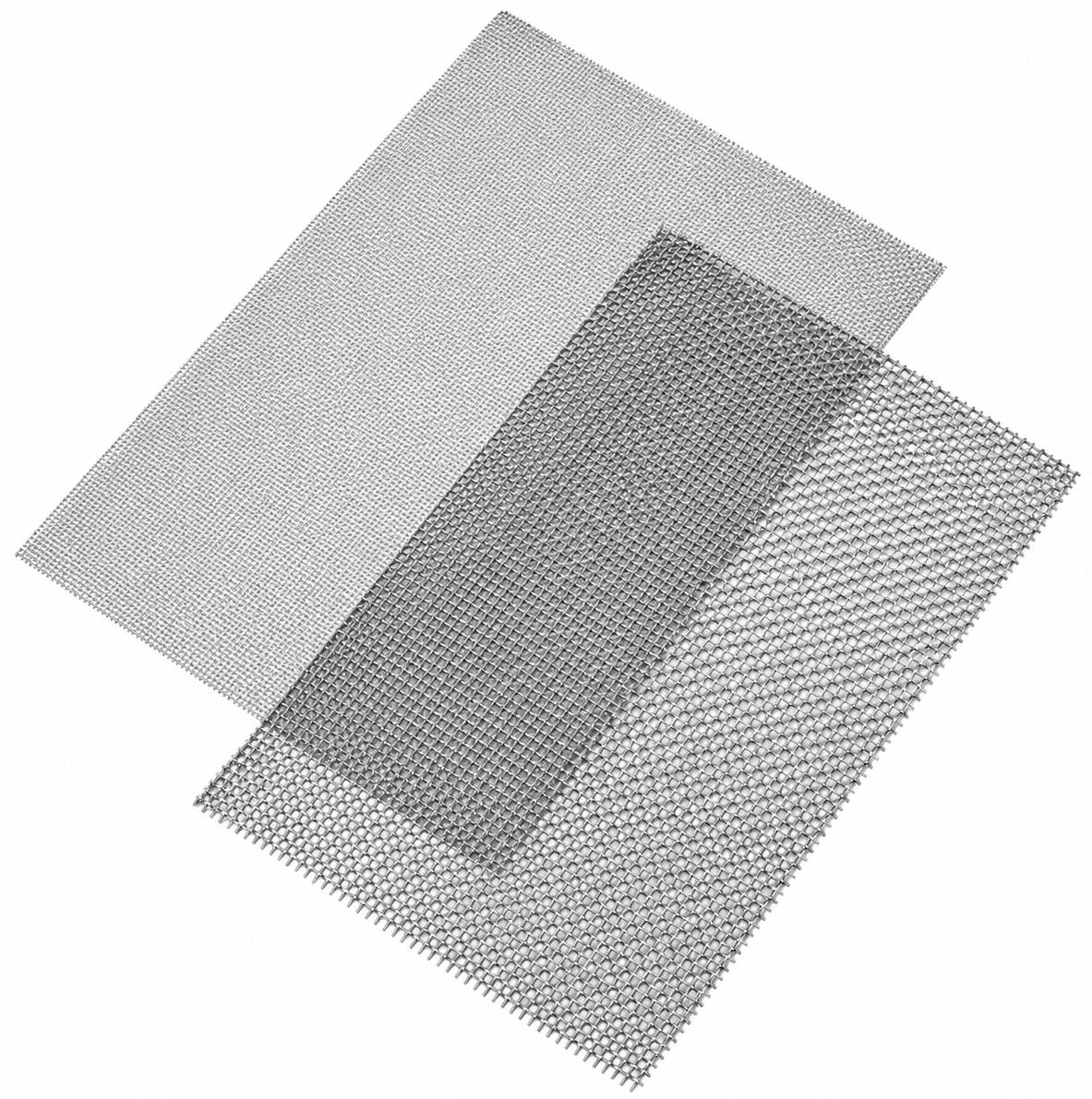
Application and Selection.
Mesh count alone does not define the opening. Choose aperture, open area, alloy and supporting structure as part of the complete filter assembly.
- Weaves
- Plain 1/1 and twill 2/2
- Specify together
- Mesh count, wire diameter and aperture
- Supply forms
- Sheets, rolls and cut components
Technical Information
Open a section to view the details, tables and illustrations.
Weave Structure & Mesh Geometry
Understanding Plain and Twill Weaves
Plain weave alternates one wire over and one under. A 2/2 twill passes over two and under two, with successive wires offset to produce a diagonal pattern.
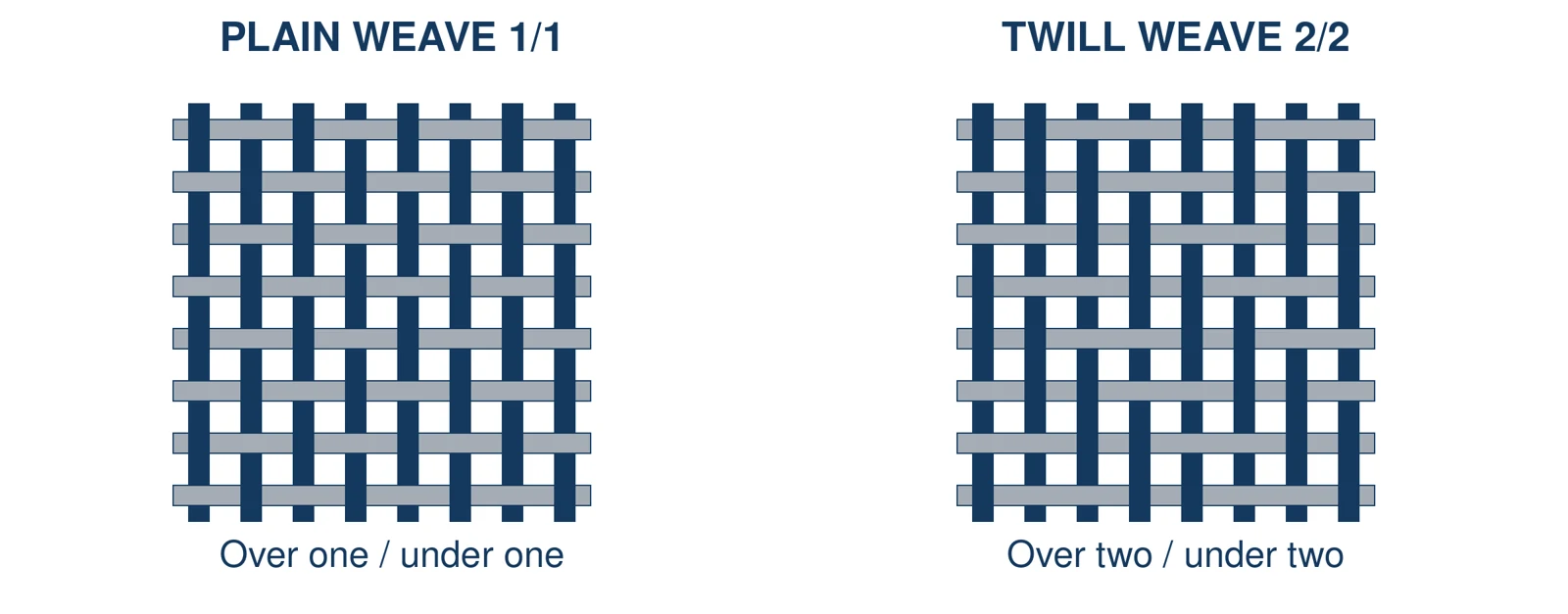
Schematic plan views; navy = warp, grey = weft. Not to scale.
Term | Meaning |
|---|---|
Mesh Count, (N) | Number of openings per linear inch. |
Wire Diameter, (d) | Wire thickness; specify it together with mesh count. |
Aperture, (w) | Clear width between adjacent wires in the projected mesh plane. |
Open Area, (Ao) | Percentage of projected surface occupied by the openings. |
Geometry of a Square Opening
p = 25.4 / N; w = p − d; Ao (%) = 100 × (w / p)²
p = pitch; w and d are in mm. The formula uses equal spacing and wire diameter in both directions.
Worked Example
100 mesh with 0.100 mm wire gives a pitch of 0.254 mm, an aperture of 0.154 mm (154 µm), and a calculated open area of approximately 36.8%.
Mesh count alone does not define the clear opening; a different wire diameter changes the aperture.
Plain Weave Specifications
Square Mesh - SUS304
Published nominal catalogue values. Mesh count is per inch; dimensions are shown in millimetres.
Mesh Count | WIRE Ø (mm) | APERTURE (mm) | Open Area |
|---|---|---|---|
6 | 0.6 | 3.63 | 73% |
10 | 0.8 | 1.74 | 47% |
12 | 0.5 | 1.62 | 58% |
14 | 0.5 | 1.314 | 52% |
16 | 0.4 | 1.187 | 56% |
18 | 0.4 | 1.011 | 51% |
20 | 0.4 | 0.87 | 47% |
24 | 0.3 | 0.758 | 51% |
30 | 0.27 | 0.576 | 46% |
40 | 0.2 | 0.435 | 47% |
50 | 0.18 | 0.328 | 42% |
60 | 0.17 | 0.253 | 36% |
80 | 0.12 | 0.198 | 39% |
100 | 0.1 | 0.154 | 37% |
120 | 0.08 | 0.132 | 39% |
150 | 0.06 | 0.109 | 42% |
160 | 0.063 | 0.096 | 36% |
180 | 0.051 | 0.09 | 41% |
200 | 0.05 | 0.077 | 37% |
Supplier rounding is retained. Confirm the required tolerances and the final specification with TEXFIL.
Ordering Basis
Include mesh count, wire diameter, material, weave and required dimensions. For an existing filter, also provide its drawing or a verified sample.
Twill Weave Specifications
Finer Square - Mesh Options
The following entries are listed as twill weave in the source catalogue.
Mesh Count | WIRE Ø (mm) | APERTURE (mm) | Open Area | Material |
|---|---|---|---|---|
250 | 0.04 | 0.062 | 36.70% | SUS304 |
300 | 0.038 | 0.046 | 30.30% | SUS304 |
325 | 0.035 | 0.043 | 30.50% | SUS304 |
400 | 0.029 | 0.0345 | 29.50% | SUS316 |
450 | 0.0275 | 0.0289 | 26.60% | SUS316 |
500 | 0.025 | 0.0258 | 25.70% | SUS316 |
Dimensions and percentages follow the published table; confirm final tolerances at enquiry.
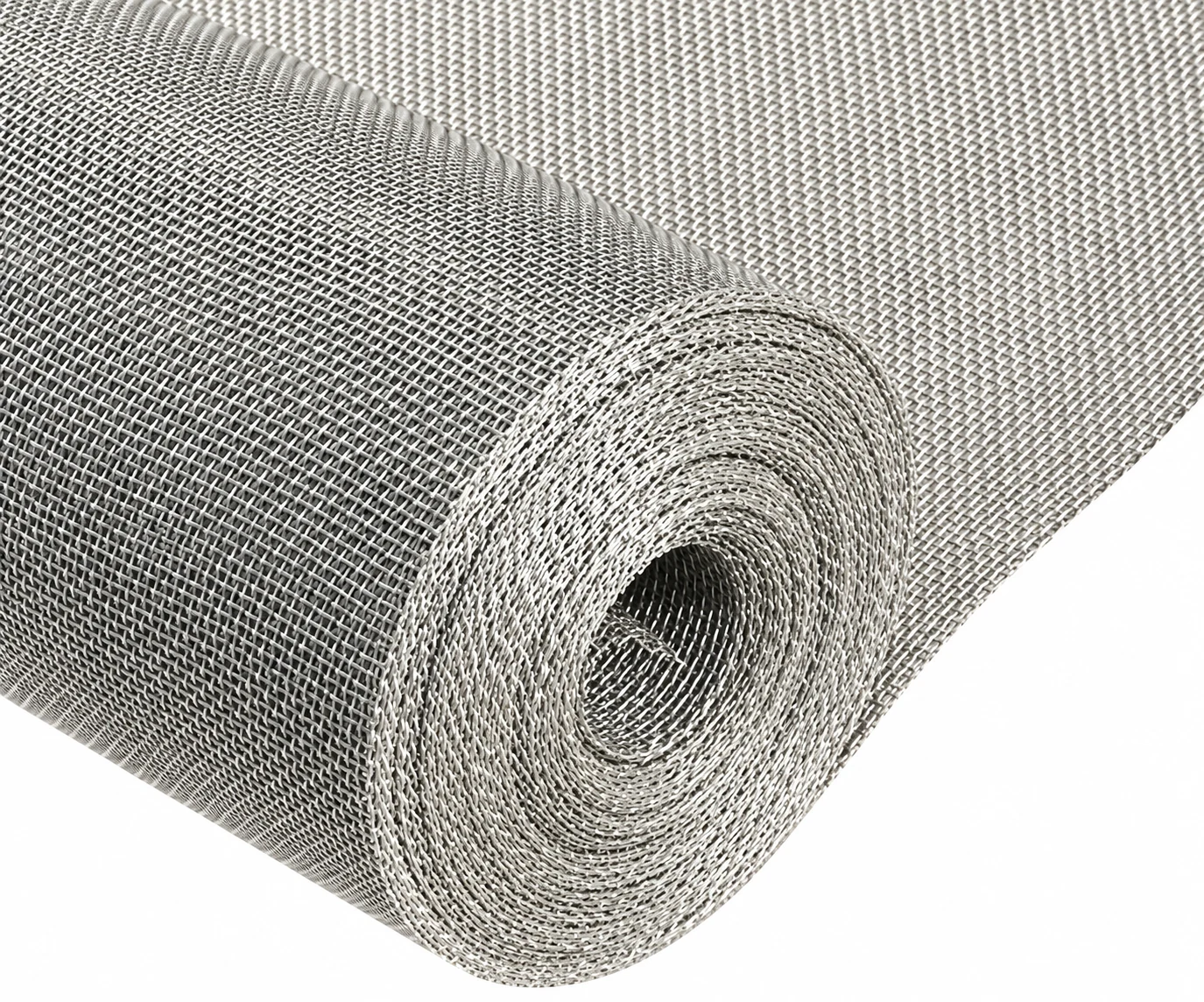
Representative woven wire mesh roll
Material Options
The published range also lists nickel, copper, aluminium, iron, galvanised wire and silver. Availability for a particular weave and size requires confirmation.
Material Review
Specify the exact grade and the process medium, operating temperature, cleaning chemicals and fabrication requirements. Suitability must be assessed for the complete duty.
Application & Technical Review
Specify the Complete Filtration Duty
Application examples include spin pack filters, candle filter assemblies, screens and filter discs.
In polymer service, review the mesh within its full layer stack and housing. Include the upstream and downstream supports, sealing arrangement and current operating history.
Review Point | Information to Provide |
|---|---|
Filtration Objective | Polymer / fluid and grade, contamination concern, required opening and target product quality. |
Process Conditions | Throughput, viscosity basis, operating temperature and pressure, and allowable differential pressure. |
Mesh Construction | Mesh count, wire diameter, aperture, weave, material grade and any surface treatment. |
Assembly & Dimensions | Drawing, roll or cut piece dimensions, tolerances, layer sequence, edge detail and support components. |
Cleaning & Handling | Cleaning method, chemicals, change interval and the condition of the current mesh or filter. |
Inspection & Supply | Required dimensional checks, material documentation, traceability, sample quantity and expected consumption. |
Balance Opening and Strength
For the same mesh count, thicker wire reduces the clear opening and open area while producing a more robust weave. Finer wire opens more flow area but requires closer attention to mechanical support.
Inspection Basis
ISO 9044:2016 covers terminology, permissible errors, requirements and tests for industrial woven wire cloth with square apertures. Agree the applicable inspection requirements for the order.
Catalogue opening size is a geometric specification. Confirm particle retention performance and pressure loss through application review and, where required, a controlled trial.
Prepare Your Enquiry
What to Send Us.
Mesh count; wire diameter; aperture; weave; alloy; dimensions; quantity; current filter reference or sample.
Discuss this product